Metadata-Version: 2.1 Name: mashumaro Version: 3.16 Summary: Fast and well tested serialization library Home-page: https://github.com/Fatal1ty/mashumaro Author: Alexander Tikhonov Author-email: random.gauss@gmail.com License: Apache License, Version 2.0 Platform: all Classifier: License :: OSI Approved :: Apache Software License Classifier: Intended Audience :: Developers Classifier: Programming Language :: Python :: 3 :: Only Classifier: Programming Language :: Python :: 3.9 Classifier: Programming Language :: Python :: 3.10 Classifier: Programming Language :: Python :: 3.11 Classifier: Programming Language :: Python :: 3.12 Classifier: Programming Language :: Python :: 3.13 Classifier: Development Status :: 5 - Production/Stable Requires-Python: >=3.9 Description-Content-Type: text/markdown License-File: LICENSE Requires-Dist: typing-extensions>=4.1.0 Provides-Extra: msgpack Requires-Dist: msgpack>=0.5.6; extra == "msgpack" Provides-Extra: orjson Requires-Dist: orjson; extra == "orjson" Provides-Extra: toml Requires-Dist: tomli-w>=1.0; extra == "toml" Requires-Dist: tomli>=1.1.0; python_version < "3.11" and extra == "toml" Provides-Extra: yaml Requires-Dist: pyyaml>=3.13; extra == "yaml"
logo ###### Fast and well tested serialization library [![Build Status](https://github.com/Fatal1ty/mashumaro/workflows/tests/badge.svg)](https://github.com/Fatal1ty/mashumaro/actions) [![Coverage Status](https://coveralls.io/repos/github/Fatal1ty/mashumaro/badge.svg?branch=master)](https://coveralls.io/github/Fatal1ty/mashumaro?branch=master) [![Latest Version](https://img.shields.io/pypi/v/mashumaro.svg)](https://pypi.python.org/pypi/mashumaro) [![Python Version](https://img.shields.io/pypi/pyversions/mashumaro.svg)](https://pypi.python.org/pypi/mashumaro) [![License](https://img.shields.io/badge/License-Apache%202.0-blue.svg)](https://opensource.org/licenses/Apache-2.0)




In Python, you often need to dump and load objects based on the schema you have. It can be a dataclass model, a list of third-party generic classes or whatever. Mashumaro not only lets you save and load things in different ways, but it also does it _super quick_. **Key features** * 🚀 One of the fastest libraries * ☝️ Mature and time-tested * 👶 Easy to use out of the box * ⚙️ Highly customizable * 🎉 Built-in support for JSON, YAML, TOML, MessagePack * 📦 Built-in support for almost all Python types including typing-extensions * 📝 JSON Schema generation Table of contents ------------------------------------------------------------------------------- * [Table of contents](#table-of-contents) * [Introduction](#introduction) * [Installation](#installation) * [Changelog](#changelog) * [Supported data types](#supported-data-types) * [Usage example](#usage-example) * [How does it work?](#how-does-it-work) * [Benchmark](#benchmark) * [Supported serialization formats](#supported-serialization-formats) * [Basic form](#basic-form) * [JSON](#json) * [json library](#json-library) * [orjson library](#orjson-library) * [YAML](#yaml) * [TOML](#toml) * [MessagePack](#messagepack) * [Customization](#customization) * [SerializableType interface](#serializabletype-interface) * [User-defined types](#user-defined-types) * [User-defined generic types](#user-defined-generic-types) * [SerializationStrategy](#serializationstrategy) * [Third-party types](#third-party-types) * [Third-party generic types](#third-party-generic-types) * [Field options](#field-options) * [`serialize` option](#serialize-option) * [`deserialize` option](#deserialize-option) * [`serialization_strategy` option](#serialization_strategy-option) * [`alias` option](#alias-option) * [Config options](#config-options) * [`debug` config option](#debug-config-option) * [`code_generation_options` config option](#code_generation_options-config-option) * [`serialization_strategy` config option](#serialization_strategy-config-option) * [`aliases` config option](#aliases-config-option) * [`serialize_by_alias` config option](#serialize_by_alias-config-option) * [`allow_deserialization_not_by_alias` config option](#allow_deserialization_not_by_alias-config-option) * [`omit_none` config option](#omit_none-config-option) * [`omit_default` config option](#omit_default-config-option) * [`namedtuple_as_dict` config option](#namedtuple_as_dict-config-option) * [`allow_postponed_evaluation` config option](#allow_postponed_evaluation-config-option) * [`dialect` config option](#dialect-config-option) * [`orjson_options` config option](#orjson_options-config-option) * [`discriminator` config option](#discriminator-config-option) * [`lazy_compilation` config option](#lazy_compilation-config-option) * [`sort_keys` config option](#sort_keys-config-option) * [`forbid_extra_keys` config option](#forbid_extra_keys-config-option) * [Passing field values as is](#passing-field-values-as-is) * [Extending existing types](#extending-existing-types) * [Field aliases](#field-aliases) * [Dialects](#dialects) * [`serialization_strategy` dialect option](#serialization_strategy-dialect-option) * [`serialize_by_alias` dialect option](#serialize_by_alias-dialect-option) * [`omit_none` dialect option](#omit_none-dialect-option) * [`omit_default` dialect option](#omit_default-dialect-option) * [`namedtuple_as_dict` dialect option](#namedtuple_as_dict-dialect-option) * [`no_copy_collections` dialect option](#no_copy_collections-dialect-option) * [Changing the default dialect](#changing-the-default-dialect) * [Discriminator](#discriminator) * [Subclasses distinguishable by a field](#subclasses-distinguishable-by-a-field) * [Subclasses without a common field](#subclasses-without-a-common-field) * [Class level discriminator](#class-level-discriminator) * [Working with union of classes](#working-with-union-of-classes) * [Using a custom variant tagger function](#using-a-custom-variant-tagger-function) * [Code generation options](#code-generation-options) * [Add `omit_none` keyword argument](#add-omit_none-keyword-argument) * [Add `by_alias` keyword argument](#add-by_alias-keyword-argument) * [Add `dialect` keyword argument](#add-dialect-keyword-argument) * [Add `context` keyword argument](#add-context-keyword-argument) * [Generic dataclasses](#generic-dataclasses) * [Generic dataclass inheritance](#generic-dataclass-inheritance) * [Generic dataclass in a field type](#generic-dataclass-in-a-field-type) * [GenericSerializableType interface](#genericserializabletype-interface) * [Serialization hooks](#serialization-hooks) * [Before deserialization](#before-deserialization) * [After deserialization](#after-deserialization) * [Before serialization](#before-serialization) * [After serialization](#after-serialization) * [JSON Schema](#json-schema) * [Building JSON Schema](#building-json-schema) * [JSON Schema constraints](#json-schema-constraints) * [JSON Schema plugins](#json-schema-plugins) * [Extending JSON Schema](#extending-json-schema) * [JSON Schema and custom serialization methods](#json-schema-and-custom-serialization-methods) Introduction ------------------------------------------------------------------------------- This library provides two fundamentally different approaches to converting your data to and from various formats. Each of them is useful in different situations: * Codecs * Mixins Codecs are represented by a set of decoder / encoder classes and decode / encode functions for each supported format. You can use them to convert data of any python built-in and third-party type to JSON, YAML, TOML, MessagePack or a basic form accepted by other serialization formats. For example, you can convert a list of datetime objects to JSON array containing string-represented datetimes and vice versa. Mixins are primarily for dataclass models. They are represented by mixin classes that add methods for converting to and from JSON, YAML, TOML, MessagePack or a basic form accepted by other serialization formats. If you have a root dataclass model, then it will be the easiest way to make it serializable. All you have to do is inherit a particular mixin class. In addition to serialization functionality, this library also provides JSON Schema builder that can be used in places where interoperability matters. Installation ------------------------------------------------------------------------------- Use pip to install: ```shell $ pip install mashumaro ``` The current version of `mashumaro` supports Python versions 3.9 — 3.13. It's not recommended to use any version of Python that has reached its [end of life](https://devguide.python.org/versions/) and is no longer receiving security updates or bug fixes from the Python development team. For convenience, there is a table below that outlines the last version of `mashumaro` that can be installed on unmaintained versions of Python. | Python Version | Last Version of mashumaro | Python EOL | |----------------|--------------------------------------------------------------------|------------| | 3.8 | [3.14](https://github.com/Fatal1ty/mashumaro/releases/tag/v3.14) | 2024-10-07 | | 3.7 | [3.9.1](https://github.com/Fatal1ty/mashumaro/releases/tag/v3.9.1) | 2023-06-27 | | 3.6 | [3.1.1](https://github.com/Fatal1ty/mashumaro/releases/tag/v3.1.1) | 2021-12-23 | Changelog ------------------------------------------------------------------------------- This project follows the principles of [Semantic Versioning](https://semver.org). Changelog is available on [GitHub Releases page](https://github.com/Fatal1ty/mashumaro/releases). Supported data types ------------------------------------------------------------------------------- There is support for generic types from the standard [`typing`](https://docs.python.org/3/library/typing.html) module: * [`List`](https://docs.python.org/3/library/typing.html#typing.List) * [`Tuple`](https://docs.python.org/3/library/typing.html#typing.Tuple) * [`NamedTuple`](https://docs.python.org/3/library/typing.html#typing.NamedTuple) * [`Set`](https://docs.python.org/3/library/typing.html#typing.Set) * [`FrozenSet`](https://docs.python.org/3/library/typing.html#typing.FrozenSet) * [`Deque`](https://docs.python.org/3/library/typing.html#typing.Deque) * [`Dict`](https://docs.python.org/3/library/typing.html#typing.Dict) * [`OrderedDict`](https://docs.python.org/3/library/typing.html#typing.OrderedDict) * [`DefaultDict`](https://docs.python.org/3/library/typing.html#typing.DefaultDict) * [`TypedDict`](https://docs.python.org/3/library/typing.html#typing.TypedDict) * [`Mapping`](https://docs.python.org/3/library/typing.html#typing.Mapping) * [`MutableMapping`](https://docs.python.org/3/library/typing.html#typing.MutableMapping) * [`Counter`](https://docs.python.org/3/library/typing.html#typing.Counter) * [`ChainMap`](https://docs.python.org/3/library/typing.html#typing.ChainMap) * [`Sequence`](https://docs.python.org/3/library/typing.html#typing.Sequence) for standard generic types on [PEP 585](https://www.python.org/dev/peps/pep-0585/) compatible Python (3.9+): * [`list`](https://docs.python.org/3/library/stdtypes.html#list) * [`tuple`](https://docs.python.org/3/library/stdtypes.html#tuple) * [`namedtuple`](https://docs.python.org/3/library/collections.html#collections.namedtuple) * [`set`](https://docs.python.org/3/library/stdtypes.html#set) * [`frozenset`](https://docs.python.org/3/library/stdtypes.html#frozenset) * [`collections.abc.Set`](https://docs.python.org/3/library/collections.abc.html#collections.abc.Set) * [`collections.abc.MutableSet`](https://docs.python.org/3/library/collections.abc.html#collections.abc.MutableSet) * [`collections.deque`](https://docs.python.org/3/library/collections.html#collections.deque) * [`dict`](https://docs.python.org/3/library/stdtypes.html#dict) * [`collections.OrderedDict`](https://docs.python.org/3/library/collections.html#collections.OrderedDict) * [`collections.defaultdict`](https://docs.python.org/3/library/collections.html#collections.defaultdict) * [`collections.abc.Mapping`](https://docs.python.org/3/library/collections.abc.html#collections.abc.Mapping) * [`collections.abc.MutableMapping`](https://docs.python.org/3/library/collections.abc.html#collections.abc.MutableMapping) * [`collections.Counter`](https://docs.python.org/3/library/collections.html#collections.Counter) * [`collections.ChainMap`](https://docs.python.org/3/library/collections.html#collections.ChainMap) * [`collections.abc.Sequence`](https://docs.python.org/3/library/collections.abc.html#collections.abc.Sequence) * [`collections.abc.MutableSequence`](https://docs.python.org/3/library/collections.abc.html#collections.abc.MutableSequence) for special primitives from the [`typing`](https://docs.python.org/3/library/typing.html) module: * [`Any`](https://docs.python.org/3/library/typing.html#typing.Any) * [`Optional`](https://docs.python.org/3/library/typing.html#typing.Optional) * [`Union`](https://docs.python.org/3/library/typing.html#typing.Union) * [`TypeVar`](https://docs.python.org/3/library/typing.html#typing.TypeVar) * [`TypeVarTuple`](https://docs.python.org/3/library/typing.html#typing.TypeVarTuple) * [`NewType`](https://docs.python.org/3/library/typing.html#newtype) * [`Annotated`](https://docs.python.org/3/library/typing.html#typing.Annotated) * [`Literal`](https://docs.python.org/3/library/typing.html#typing.Literal) * [`LiteralString`](https://docs.python.org/3/library/typing.html#typing.LiteralString) * [`Final`](https://docs.python.org/3/library/typing.html#typing.Final) * [`Self`](https://docs.python.org/3/library/typing.html#typing.Self) * [`Unpack`](https://docs.python.org/3/library/typing.html#typing.Unpack) * [`ReadOnly`](https://docs.python.org/3/library/typing.html#typing.ReadOnly) for standard interpreter types from [`types`](https://docs.python.org/3/library/types.html#standard-interpreter-types) module: * [`NoneType`](https://docs.python.org/3/library/types.html#types.NoneType) * [`UnionType`](https://docs.python.org/3/library/types.html#types.UnionType) * [`MappingProxyType`](https://docs.python.org/3/library/types.html#types.MappingProxyType) for enumerations based on classes from the standard [`enum`](https://docs.python.org/3/library/enum.html) module: * [`Enum`](https://docs.python.org/3/library/enum.html#enum.Enum) * [`IntEnum`](https://docs.python.org/3/library/enum.html#enum.IntEnum) * [`StrEnum`](https://docs.python.org/3/library/enum.html#enum.StrEnum) * [`Flag`](https://docs.python.org/3/library/enum.html#enum.Flag) * [`IntFlag`](https://docs.python.org/3/library/enum.html#enum.IntFlag) for common built-in types: * [`int`](https://docs.python.org/3/library/functions.html#int) * [`float`](https://docs.python.org/3/library/functions.html#float) * [`bool`](https://docs.python.org/3/library/stdtypes.html#bltin-boolean-values) * [`str`](https://docs.python.org/3/library/stdtypes.html#str) * [`bytes`](https://docs.python.org/3/library/stdtypes.html#bytes) * [`bytearray`](https://docs.python.org/3/library/stdtypes.html#bytearray) for built-in datetime oriented types (see [more](#deserialize-option) details): * [`datetime`](https://docs.python.org/3/library/datetime.html#datetime.datetime) * [`date`](https://docs.python.org/3/library/datetime.html#datetime.date) * [`time`](https://docs.python.org/3/library/datetime.html#datetime.time) * [`timedelta`](https://docs.python.org/3/library/datetime.html#datetime.timedelta) * [`timezone`](https://docs.python.org/3/library/datetime.html#datetime.timezone) * [`ZoneInfo`](https://docs.python.org/3/library/zoneinfo.html#zoneinfo.ZoneInfo) for pathlike types: * [`PurePath`](https://docs.python.org/3/library/pathlib.html#pathlib.PurePath) * [`Path`](https://docs.python.org/3/library/pathlib.html#pathlib.Path) * [`PurePosixPath`](https://docs.python.org/3/library/pathlib.html#pathlib.PurePosixPath) * [`PosixPath`](https://docs.python.org/3/library/pathlib.html#pathlib.PosixPath) * [`PureWindowsPath`](https://docs.python.org/3/library/pathlib.html#pathlib.PureWindowsPath) * [`WindowsPath`](https://docs.python.org/3/library/pathlib.html#pathlib.WindowsPath) * [`os.PathLike`](https://docs.python.org/3/library/os.html#os.PathLike) for other less popular built-in types: * [`uuid.UUID`](https://docs.python.org/3/library/uuid.html#uuid.UUID) * [`decimal.Decimal`](https://docs.python.org/3/library/decimal.html#decimal.Decimal) * [`fractions.Fraction`](https://docs.python.org/3/library/fractions.html#fractions.Fraction) * [`ipaddress.IPv4Address`](https://docs.python.org/3/library/ipaddress.html#ipaddress.IPv4Address) * [`ipaddress.IPv6Address`](https://docs.python.org/3/library/ipaddress.html#ipaddress.IPv6Address) * [`ipaddress.IPv4Network`](https://docs.python.org/3/library/ipaddress.html#ipaddress.IPv4Network) * [`ipaddress.IPv6Network`](https://docs.python.org/3/library/ipaddress.html#ipaddress.IPv6Network) * [`ipaddress.IPv4Interface`](https://docs.python.org/3/library/ipaddress.html#ipaddress.IPv4Interface) * [`ipaddress.IPv6Interface`](https://docs.python.org/3/library/ipaddress.html#ipaddress.IPv6Interface) * [`typing.Pattern`](https://docs.python.org/3/library/typing.html#typing.Pattern) * [`re.Pattern`](https://docs.python.org/3/library/re.html#re.Pattern) for backported types from [`typing-extensions`](https://github.com/python/typing_extensions): * [`OrderedDict`](https://docs.python.org/3/library/typing.html#typing.OrderedDict) * [`TypedDict`](https://docs.python.org/3/library/typing.html#typing.TypedDict) * [`Annotated`](https://docs.python.org/3/library/typing.html#typing.Annotated) * [`Literal`](https://docs.python.org/3/library/typing.html#typing.Literal) * [`LiteralString`](https://docs.python.org/3/library/typing.html#typing.LiteralString) * [`Self`](https://docs.python.org/3/library/typing.html#typing.Self) * [`TypeVarTuple`](https://docs.python.org/3/library/typing.html#typing.TypeVarTuple) * [`Unpack`](https://docs.python.org/3/library/typing.html#typing.Unpack) * [`ReadOnly`](https://docs.python.org/3/library/typing.html#typing.ReadOnly) for arbitrary types: * [user-defined types](#user-defined-types) * [third-party types](#third-party-types) * [user-defined generic types](#user-defined-generic-types) * [third-party generic types](#third-party-generic-types) Usage example ------------------------------------------------------------------------------- Suppose we're developing a financial application and we operate with currencies and stocks: ```python from dataclasses import dataclass from enum import Enum class Currency(Enum): USD = "USD" EUR = "EUR" @dataclass class CurrencyPosition: currency: Currency balance: float @dataclass class StockPosition: ticker: str name: str balance: int ``` Now we want a dataclass for portfolio that will be serialized to and from JSON. We inherit `DataClassJSONMixin` that adds this functionality: ```python from mashumaro.mixins.json import DataClassJSONMixin ... @dataclass class Portfolio(DataClassJSONMixin): currencies: list[CurrencyPosition] stocks: list[StockPosition] ``` Let's create a portfolio instance and check methods `from_json` and `to_json`: ```python portfolio = Portfolio( currencies=[ CurrencyPosition(Currency.USD, 238.67), CurrencyPosition(Currency.EUR, 361.84), ], stocks=[ StockPosition("AAPL", "Apple", 10), StockPosition("AMZN", "Amazon", 10), ] ) portfolio_json = portfolio.to_json() assert Portfolio.from_json(portfolio_json) == portfolio ``` If we need to serialize something different from a root dataclass, we can use codecs. In the following example we create a JSON decoder and encoder for a list of currencies: ```python from mashumaro.codecs.json import JSONDecoder, JSONEncoder ... decoder = JSONDecoder(list[CurrencyPosition]) encoder = JSONEncoder(list[CurrencyPosition]) currencies = [ CurrencyPosition(Currency.USD, 238.67), CurrencyPosition(Currency.EUR, 361.84), ] currencies_json = encoder.encode(currencies) assert decoder.decode(currencies_json) == currencies ``` How does it work? ------------------------------------------------------------------------------- This library works by taking the schema of the data and generating a specific decoder and encoder for exactly that schema, taking into account the specifics of serialization format. This is much faster than inspection of data types on every call of decoding or encoding at runtime. These specific decoders and encoders are generated by [codecs and mixins](#supported-serialization-formats): * When using codecs, these methods are compiled during the creation of the decoder or encoder. * When using serialization mixins, these methods are compiled during import time (or at runtime in some cases) and are set as attributes to your dataclasses. To minimize the import time, you can explicitly enable [lazy compilation](#lazy_compilation-config-option). Benchmark ------------------------------------------------------------------------------- * macOS 15.1 Sequoia * Apple M3 Max * 36GB RAM * Python 3.13.0 Benchmark using [pyperf](https://github.com/psf/pyperf) with GitHub Issue model. Please note that the following charts use logarithmic scale, as it is convenient for displaying very large ranges of values. > [!NOTE]\ > Benchmark results may vary depending on the specific configuration and > parameters used for serialization and deserialization. However, we have made > an attempt to use the available options that can speed up and smooth out the > differences in how libraries work. To run benchmark in your environment: ```bash git clone git@github.com:Fatal1ty/mashumaro.git cd mashumaro python3 -m venv env && source env/bin/activate pip install -e . pip install -r requirements-dev.txt ./benchmark/run.sh ``` Supported serialization formats ------------------------------------------------------------------------------- This library has built-in support for multiple popular formats: * [JSON](https://www.json.org) * [YAML](https://yaml.org) * [TOML](https://toml.io) * [MessagePack](https://msgpack.org) There are preconfigured codecs and mixin classes. However, you're free to override some settings if necessary. > [!IMPORTANT]\ > As for codecs, you are > offered to choose between convenience and efficiency. When you need to decode > or encode typed data more than once, it's highly recommended to create > and reuse a decoder or encoder specifically for that data type. For one-time > use with default settings it may be convenient to use global functions that > create a disposable decoder or encoder under the hood. Remember that you > should not use these convenient global functions more that once for the same > data type if performance is important to you. ### Basic form Basic form denotes a python object consisting only of basic data types supported by most serialization formats. These types are: [`str`](https://docs.python.org/3/library/stdtypes.html#str), [`int`](https://docs.python.org/3/library/functions.html#int), [`float`](https://docs.python.org/3/library/functions.html#float), [`bool`](https://docs.python.org/3/library/stdtypes.html#bltin-boolean-values), [`list`](https://docs.python.org/3/library/stdtypes.html#list), [`dict`](https://docs.python.org/3/library/stdtypes.html#dict). This is also a starting point you can play with for a comprehensive transformation of your data. Efficient decoder and encoder can be used as follows: ```python from mashumaro.codecs import BasicDecoder, BasicEncoder # or from mashumaro.codecs.basic import BasicDecoder, BasicEncoder decoder = BasicDecoder(, ...) decoder.decode(...) encoder = BasicEncoder(, ...) encoder.encode(...) ``` Convenient functions are recommended to be used as follows: ```python import mashumaro.codecs.basic as basic_codec basic_codec.decode(..., ) basic_codec.encode(..., ) ``` Mixin can be used as follows: ```python from mashumaro import DataClassDictMixin # or from mashumaro.mixins.dict import DataClassDictMixin @dataclass class MyModel(DataClassDictMixin): ... MyModel.from_dict(...) MyModel(...).to_dict() ``` > [!TIP]\ > You don't need to inherit `DataClassDictMixin` along with other serialization > mixins because it's a base class for them. ### JSON [JSON](https://www.json.org) is a lightweight data-interchange format. You can choose between standard library [json](https://docs.python.org/3/library/json.html) for compatibility and third-party dependency [orjson](https://pypi.org/project/orjson/) for better performance. #### json library Efficient decoder and encoder can be used as follows: ```python from mashumaro.codecs.json import JSONDecoder, JSONEncoder decoder = JSONDecoder(, ...) decoder.decode(...) encoder = JSONEncoder(, ...) encoder.encode(...) ``` Convenient functions can be used as follows: ```python from mashumaro.codecs.json import json_decode, json_encode json_decode(..., ) json_encode(..., ) ``` Convenient function aliases are recommended to be used as follows: ```python import mashumaro.codecs.json as json_codec json_codec.decode(...) json_codec.encode(..., ) ``` Mixin can be used as follows: ```python from mashumaro.mixins.json import DataClassJSONMixin @dataclass class MyModel(DataClassJSONMixin): ... MyModel.from_json(...) MyModel(...).to_json() ``` #### orjson library In order to use [`orjson`](https://pypi.org/project/orjson/) library, it must be installed manually or using an extra option for `mashumaro`: ```shell pip install mashumaro[orjson] ``` The following data types will be handled by [`orjson`](https://pypi.org/project/orjson/) library by default: * [`datetime`](https://docs.python.org/3/library/datetime.html#datetime.datetime) * [`date`](https://docs.python.org/3/library/datetime.html#datetime.date) * [`time`](https://docs.python.org/3/library/datetime.html#datetime.time) * [`uuid.UUID`](https://docs.python.org/3/library/uuid.html#uuid.UUID) Efficient decoder and encoder can be used as follows: ```python from mashumaro.codecs.orjson import ORJSONDecoder, ORJSONEncoder decoder = ORJSONDecoder(, ...) decoder.decode(...) encoder = ORJSONEncoder(, ...) encoder.encode(...) ``` Convenient functions can be used as follows: ```python from mashumaro.codecs.orjson import json_decode, json_encode json_decode(..., ) json_encode(..., ) ``` Convenient function aliases are recommended to be used as follows: ```python import mashumaro.codecs.orjson as json_codec json_codec.decode(...) json_codec.encode(..., ) ``` Mixin can be used as follows: ```python from mashumaro.mixins.orjson import DataClassORJSONMixin @dataclass class MyModel(DataClassORJSONMixin): ... MyModel.from_json(...) MyModel(...).to_json() MyModel(...).to_jsonb() ``` ### YAML [YAML](https://yaml.org) is a human-friendly data serialization language for all programming languages. In order to use this format, the [`pyyaml`](https://pypi.org/project/PyYAML/) package must be installed. You can install it manually or using an extra option for `mashumaro`: ```shell pip install mashumaro[yaml] ``` Efficient decoder and encoder can be used as follows: ```python from mashumaro.codecs.yaml import YAMLDecoder, YAMLEncoder decoder = YAMLDecoder(, ...) decoder.decode(...) encoder = YAMLEncoder(, ...) encoder.encode(...) ``` Convenient functions can be used as follows: ```python from mashumaro.codecs.yaml import yaml_decode, yaml_encode yaml_decode(..., ) yaml_encode(..., ) ``` Convenient function aliases are recommended to be used as follows: ```python import mashumaro.codecs.yaml as yaml_codec yaml_codec.decode(...) yaml_codec.encode(..., ) ``` Mixin can be used as follows: ```python from mashumaro.mixins.yaml import DataClassYAMLMixin @dataclass class MyModel(DataClassYAMLMixin): ... MyModel.from_yaml(...) MyModel(...).to_yaml() ``` ### TOML [TOML](https://toml.io) is config file format for humans. In order to use this format, the [`tomli`](https://pypi.org/project/tomli/) and [`tomli-w`](https://pypi.org/project/tomli-w/) packages must be installed. In Python 3.11+, `tomli` is included as [`tomlib`](https://docs.python.org/3/library/tomllib.html) standard library module and is used for this format. You can install the missing packages manually or using an extra option for `mashumaro`: ```shell pip install mashumaro[toml] ``` The following data types will be handled by [`tomli`](https://pypi.org/project/tomli/)/ [`tomli-w`](https://pypi.org/project/tomli-w/) library by default: * [`datetime`](https://docs.python.org/3/library/datetime.html#datetime.datetime) * [`date`](https://docs.python.org/3/library/datetime.html#datetime.date) * [`time`](https://docs.python.org/3/library/datetime.html#datetime.time) Fields with value `None` will be omitted on serialization because TOML doesn't support null values. Efficient decoder and encoder can be used as follows: ```python from mashumaro.codecs.toml import TOMLDecoder, TOMLEncoder decoder = TOMLDecoder(, ...) decoder.decode(...) encoder = TOMLEncoder(, ...) encoder.encode(...) ``` Convenient functions can be used as follows: ```python from mashumaro.codecs.toml import toml_decode, toml_encode toml_decode(..., ) toml_encode(..., ) ``` Convenient function aliases are recommended to be used as follows: ```python import mashumaro.codecs.toml as toml_codec toml_codec.decode(...) toml_codec.encode(..., ) ``` Mixin can be used as follows: ```python from mashumaro.mixins.toml import DataClassTOMLMixin @dataclass class MyModel(DataClassTOMLMixin): ... MyModel.from_toml(...) MyModel(...).to_toml() ``` ### MessagePack [MessagePack](https://msgpack.org) is an efficient binary serialization format. In order to use this mixin, the [`msgpack`](https://pypi.org/project/msgpack/) package must be installed. You can install it manually or using an extra option for `mashumaro`: ```shell pip install mashumaro[msgpack] ``` The following data types will be handled by [`msgpack`](https://pypi.org/project/msgpack/) library by default: * [`bytes`](https://docs.python.org/3/library/stdtypes.html#bytes) * [`bytearray`](https://docs.python.org/3/library/stdtypes.html#bytearray) Efficient decoder and encoder can be used as follows: ```python from mashumaro.codecs.msgpack import MessagePackDecoder, MessagePackEncoder decoder = MessagePackDecoder(, ...) decoder.decode(...) encoder = MessagePackEncoder(, ...) encoder.encode(...) ``` Convenient functions can be used as follows: ```python from mashumaro.codecs.msgpack import msgpack_decode, msgpack_encode msgpack_decode(..., ) msgpack_encode(..., ) ``` Convenient function aliases are recommended to be used as follows: ```python import mashumaro.codecs.msgpack as msgpack_codec msgpack_codec.decode(...) msgpack_codec.encode(..., ) ``` Mixin can be used as follows: ```python from mashumaro.mixins.msgpack import DataClassMessagePackMixin @dataclass class MyModel(DataClassMessagePackMixin): ... MyModel.from_msgpack(...) MyModel(...).to_msgpack() ``` Customization ------------------------------------------------------------------------------- Customization options of `mashumaro` are extensive and will most likely cover your needs. When it comes to non-standard data types and non-standard serialization support, you can do the following: * Turn an existing regular or generic class into a serializable one by inheriting the [`SerializableType`](#serializabletype-interface) class * Write different serialization strategies for an existing regular or generic type that is not under your control using [`SerializationStrategy`](#serializationstrategy) class * Define serialization / deserialization methods: * for a specific dataclass field by using [field options](#field-options) * for a specific data type used in the dataclass by using [`Config`](#config-options) class * Alter input and output data with serialization / deserialization [hooks](#serialization-hooks) * Separate serialization scheme from a dataclass in a reusable manner using [dialects](#dialects) * Choose from predefined serialization engines for the specific data types, e.g. `datetime` and `NamedTuple` ### SerializableType interface If you have a custom class or hierarchy of classes whose instances you want to serialize with `mashumaro`, the first option is to implement `SerializableType` interface. #### User-defined types Let's look at this not very practicable example: ```python from dataclasses import dataclass from mashumaro import DataClassDictMixin from mashumaro.types import SerializableType class Airport(SerializableType): def __init__(self, code, city): self.code, self.city = code, city def _serialize(self): return [self.code, self.city] @classmethod def _deserialize(cls, value): return cls(*value) def __eq__(self, other): return self.code, self.city == other.code, other.city @dataclass class Flight(DataClassDictMixin): origin: Airport destination: Airport JFK = Airport("JFK", "New York City") LAX = Airport("LAX", "Los Angeles") input_data = { "origin": ["JFK", "New York City"], "destination": ["LAX", "Los Angeles"] } my_flight = Flight.from_dict(input_data) assert my_flight == Flight(JFK, LAX) assert my_flight.to_dict() == input_data ``` You can see how `Airport` instances are seamlessly created from lists of two strings and serialized into them. By default `_deserialize` method will get raw input data without any transformations before. This should be enough in many cases, especially when you need to perform non-standard transformations yourself, but let's extend our example: ```python class Itinerary(SerializableType): def __init__(self, flights): self.flights = flights def _serialize(self): return self.flights @classmethod def _deserialize(cls, flights): return cls(flights) @dataclass class TravelPlan(DataClassDictMixin): budget: float itinerary: Itinerary input_data = { "budget": 10_000, "itinerary": [ { "origin": ["JFK", "New York City"], "destination": ["LAX", "Los Angeles"] }, { "origin": ["LAX", "Los Angeles"], "destination": ["SFO", "San Fransisco"] } ] } ``` If we pass the flight list as is into `Itinerary._deserialize`, our itinerary will have something that we may not expect — `list[dict]` instead of `list[Flight]`. The solution is quite simple. Instead of calling `Flight._deserialize` yourself, just use annotations: ```python class Itinerary(SerializableType, use_annotations=True): def __init__(self, flights): self.flights = flights def _serialize(self) -> list[Flight]: return self.flights @classmethod def _deserialize(cls, flights: list[Flight]): return cls(flights) my_plan = TravelPlan.from_dict(input_data) assert isinstance(my_plan.itinerary.flights[0], Flight) assert isinstance(my_plan.itinerary.flights[1], Flight) assert my_plan.to_dict() == input_data ``` Here we add annotations to the only argument of `_deserialize` method and to the return value of `_serialize` method as well. The latter is needed for correct serialization. > [!IMPORTANT]\ > The importance of explicit passing `use_annotations=True` when defining a > class is that otherwise implicit using annotations might break compatibility > with old code that wasn't aware of this feature. It will be enabled by > default in the future major release. #### User-defined generic types The great thing to note about using annotations in `SerializableType` is that they work seamlessly with [generic](https://docs.python.org/3/library/typing.html#user-defined-generic-types) and [variadic generic](https://peps.python.org/pep-0646/) types. Let's see how this can be useful: ```python from datetime import date from typing import TypeVar from dataclasses import dataclass from mashumaro import DataClassDictMixin from mashumaro.types import SerializableType KT = TypeVar("KT") VT = TypeVar("VT") class DictWrapper(dict[KT, VT], SerializableType, use_annotations=True): def _serialize(self) -> dict[KT, VT]: return dict(self) @classmethod def _deserialize(cls, value: dict[KT, VT]) -> 'DictWrapper[KT, VT]': return cls(value) @dataclass class DataClass(DataClassDictMixin): x: DictWrapper[date, str] y: DictWrapper[str, date] input_data = { "x": {"2022-12-07": "2022-12-07"}, "y": {"2022-12-07": "2022-12-07"} } obj = DataClass.from_dict(input_data) assert obj == DataClass( x=DictWrapper({date(2022, 12, 7): "2022-12-07"}), y=DictWrapper({"2022-12-07": date(2022, 12, 7)}) ) assert obj.to_dict() == input_data ``` You can see that formatted date is deserialized to `date` object before passing to `DictWrapper._deserialize` in a key or value according to the generic parameters. If you have generic dataclass types, you can use `SerializableType` for them as well, but it's not necessary since they're [supported](#generic-dataclasses) out of the box. ### SerializationStrategy If you want to add support for a custom third-party type that is not under your control, you can write serialization and deserialization logic inside `SerializationStrategy` class, which will be reusable and so well suited in case that third-party type is widely used. `SerializationStrategy` is also good if you want to create strategies that are slightly different from each other, because you can add the strategy differentiator in the `__init__` method. #### Third-party types To demonstrate how `SerializationStrategy` works let's write a simple strategy for datetime serialization in different formats. In this example we will use the same strategy class for two dataclass fields, but a string representing the date and time will be different. ```python from dataclasses import dataclass, field from datetime import datetime from mashumaro import DataClassDictMixin, field_options from mashumaro.types import SerializationStrategy class FormattedDateTime(SerializationStrategy): def __init__(self, fmt): self.fmt = fmt def serialize(self, value: datetime) -> str: return value.strftime(self.fmt) def deserialize(self, value: str) -> datetime: return datetime.strptime(value, self.fmt) @dataclass class DateTimeFormats(DataClassDictMixin): short: datetime = field( metadata=field_options( serialization_strategy=FormattedDateTime("%d%m%Y%H%M%S") ) ) verbose: datetime = field( metadata=field_options( serialization_strategy=FormattedDateTime("%A %B %d, %Y, %H:%M:%S") ) ) formats = DateTimeFormats( short=datetime(2019, 1, 1, 12), verbose=datetime(2019, 1, 1, 12), ) dictionary = formats.to_dict() # {'short': '01012019120000', 'verbose': 'Tuesday January 01, 2019, 12:00:00'} assert DateTimeFormats.from_dict(dictionary) == formats ``` Similarly to `SerializableType`, `SerializationStrategy` could also take advantage of annotations: ```python from dataclasses import dataclass from datetime import datetime from mashumaro import DataClassDictMixin from mashumaro.types import SerializationStrategy class TsSerializationStrategy(SerializationStrategy, use_annotations=True): def serialize(self, value: datetime) -> float: return value.timestamp() def deserialize(self, value: float) -> datetime: # value will be converted to float before being passed to this method return datetime.fromtimestamp(value) @dataclass class Example(DataClassDictMixin): dt: datetime class Config: serialization_strategy = { datetime: TsSerializationStrategy(), } example = Example.from_dict({"dt": "1672531200"}) print(example) # Example(dt=datetime.datetime(2023, 1, 1, 3, 0)) print(example.to_dict()) # {'dt': 1672531200.0} ``` Here the passed string value `"1672531200"` will be converted to `float` before being passed to `deserialize` method thanks to the `float` annotation. > [!IMPORTANT]\ > As well as for `SerializableType`, the value of `use_annotatons` will be > `True` by default in the future major release. #### Third-party generic types To create a generic version of a serialization strategy you need to follow these steps: * inherit [`Generic[...]`](https://docs.python.org/3/library/typing.html#typing.Generic) type with the number of parameters matching the number of parameters of the target generic type * Write generic annotations for `serialize` method's return type and for `deserialize` method's argument type * Use the origin type of the target generic type in the [`serialization_strategy`](#serialization_strategy-config-option) config section ([`typing.get_origin`](https://docs.python.org/3/library/typing.html#typing.get_origin) might be helpful) There is no need to add `use_annotations=True` here because it's enabled implicitly for generic serialization strategies. For example, there is a third-party [multidict](https://pypi.org/project/multidict/) package that has a generic `MultiDict` type. A generic serialization strategy for it might look like this: ```python from dataclasses import dataclass from datetime import date from pprint import pprint from typing import Generic, List, Tuple, TypeVar from mashumaro import DataClassDictMixin from mashumaro.types import SerializationStrategy from multidict import MultiDict T = TypeVar("T") class MultiDictSerializationStrategy(SerializationStrategy, Generic[T]): def serialize(self, value: MultiDict[T]) -> List[Tuple[str, T]]: return [(k, v) for k, v in value.items()] def deserialize(self, value: List[Tuple[str, T]]) -> MultiDict[T]: return MultiDict(value) @dataclass class Example(DataClassDictMixin): floats: MultiDict[float] date_lists: MultiDict[List[date]] class Config: serialization_strategy = { MultiDict: MultiDictSerializationStrategy() } example = Example( floats=MultiDict([("x", 1.1), ("x", 2.2)]), date_lists=MultiDict( [("x", [date(2023, 1, 1), date(2023, 1, 2)]), ("x", [date(2023, 2, 1), date(2023, 2, 2)])] ), ) pprint(example.to_dict()) # {'date_lists': [['x', ['2023-01-01', '2023-01-02']], # ['x', ['2023-02-01', '2023-02-02']]], # 'floats': [['x', 1.1], ['x', 2.2]]} assert Example.from_dict(example.to_dict()) == example ``` ### Field options In some cases creating a new class just for one little thing could be excessive. Moreover, you may need to deal with third party classes that you are not allowed to change. You can use [`dataclasses.field`](https://docs.python.org/3/library/dataclasses.html#dataclasses.field) function to configure some serialization aspects through its `metadata` parameter. Next section describes all supported options to use in `metadata` mapping. If you don't want to remember the names of the options you can use `field_options` helper function: ```python from dataclasses import dataclass, field from mashumaro import field_options @dataclass class A: x: int = field(metadata=field_options(...)) ``` #### `serialize` option This option allows you to change the serialization method. When using this option, the serialization behaviour depends on what type of value the option has. It could be either `Callable[[Any], Any]` or `str`. A value of type `Callable[[Any], Any]` is a generic way to specify any callable object like a function, a class method, a class instance method, an instance of a callable class or even a lambda function to be called for serialization. A value of type `str` sets a specific engine for serialization. Keep in mind that all possible engines depend on the data type that this option is used with. At this moment there are next serialization engines to choose from: | Applicable data types | Supported engines | Description | |:---------------------------|:---------------------|:-------------------------------------------------------------------------------------------------------------------------------------------------------------------------------------------------------------| | `NamedTuple`, `namedtuple` | `as_list`, `as_dict` | How to pack named tuples. By default `as_list` engine is used that means your named tuple class instance will be packed into a list of its values. You can pack it into a dictionary using `as_dict` engine. | | `Any` | `omit` | Skip the field during serialization | > [!TIP]\ > You can pass a field value as is without changes on serialization using [`pass_through`](#passing-field-values-as-is). Example: ```python from datetime import datetime from dataclasses import dataclass, field from typing import NamedTuple from mashumaro import DataClassDictMixin class MyNamedTuple(NamedTuple): x: int y: float @dataclass class A(DataClassDictMixin): dt: datetime = field( metadata={ "serialize": lambda v: v.strftime('%Y-%m-%d %H:%M:%S') } ) t: MyNamedTuple = field(metadata={"serialize": "as_dict"}) ``` #### `deserialize` option This option allows you to change the deserialization method. When using this option, the deserialization behaviour depends on what type of value the option has. It could be either `Callable[[Any], Any]` or `str`. A value of type `Callable[[Any], Any]` is a generic way to specify any callable object like a function, a class method, a class instance method, an instance of a callable class or even a lambda function to be called for deserialization. A value of type `str` sets a specific engine for deserialization. Keep in mind that all possible engines depend on the data type that this option is used with. At this moment there are next deserialization engines to choose from: | Applicable data types | Supported engines | Description | |:---------------------------|:------------------------------------------------------------------------------------------------------------------------------------|:--------------------------------------------------------------------------------------------------------------------------------------------------------------------------------------------------------------------------------------------------------------------------------------------------------| | `datetime`, `date`, `time` | [`ciso8601`](https://github.com/closeio/ciso8601#supported-subset-of-iso-8601), [`pendulum`](https://github.com/sdispater/pendulum) | How to parse datetime string. By default native [`fromisoformat`](https://docs.python.org/3/library/datetime.html#datetime.datetime.fromisoformat) of corresponding class will be used for `datetime`, `date` and `time` fields. It's the fastest way in most cases, but you can choose an alternative. | | `NamedTuple`, `namedtuple` | `as_list`, `as_dict` | How to unpack named tuples. By default `as_list` engine is used that means your named tuple class instance will be created from a list of its values. You can unpack it from a dictionary using `as_dict` engine. | > [!TIP]\ > You can pass a field value as is without changes on deserialization using [`pass_through`](#passing-field-values-as-is). Example: ```python from datetime import datetime from dataclasses import dataclass, field from typing import List, NamedTuple from mashumaro import DataClassDictMixin import ciso8601 import dateutil class MyNamedTuple(NamedTuple): x: int y: float @dataclass class A(DataClassDictMixin): x: datetime = field( metadata={"deserialize": "pendulum"} ) class B(DataClassDictMixin): x: datetime = field( metadata={"deserialize": ciso8601.parse_datetime_as_naive} ) @dataclass class C(DataClassDictMixin): dt: List[datetime] = field( metadata={ "deserialize": lambda l: list(map(dateutil.parser.isoparse, l)) } ) @dataclass class D(DataClassDictMixin): x: MyNamedTuple = field(metadata={"deserialize": "as_dict"}) ``` #### `serialization_strategy` option This option is useful when you want to change the serialization logic for a dataclass field depending on some defined parameters using a reusable serialization scheme. You can find an example in the [`SerializationStrategy`](#serializationstrategy) chapter. > [!TIP]\ > You can pass a field value as is without changes on > serialization / deserialization using [`pass_through`](#passing-field-values-as-is). #### `alias` option This option can be used to assign [field aliases](#field-aliases): ```python from dataclasses import dataclass, field from mashumaro import DataClassDictMixin, field_options @dataclass class DataClass(DataClassDictMixin): a: int = field(metadata=field_options(alias="FieldA")) b: int = field(metadata=field_options(alias="#invalid")) x = DataClass.from_dict({"FieldA": 1, "#invalid": 2}) # DataClass(a=1, b=2) ``` ### Config options If inheritance is not an empty word for you, you'll fall in love with the `Config` class. You can register `serialize` and `deserialize` methods, define code generation options and other things just in one place. Or in some classes in different ways if you need flexibility. Inheritance is always on the first place. There is a base class `BaseConfig` that you can inherit for the sake of convenience, but it's not mandatory. In the following example you can see how the `debug` flag is changed from class to class: `ModelA` will have debug mode enabled but `ModelB` will not. ```python from mashumaro import DataClassDictMixin from mashumaro.config import BaseConfig class BaseModel(DataClassDictMixin): class Config(BaseConfig): debug = True class ModelA(BaseModel): a: int class ModelB(BaseModel): b: int class Config(BaseConfig): debug = False ``` Next section describes all supported options to use in the config. #### `debug` config option If you enable the `debug` option the generated code for your data class will be printed. #### `code_generation_options` config option Some users may need functionality that wouldn't exist without extra cost such as valuable cpu time to execute additional instructions. Since not everyone needs such instructions, they can be enabled by a constant in the list, so the fastest basic behavior of the library will always remain by default. The following table provides a brief overview of all the available constants described below. | Constant | Description | |:----------------------------------------------------------------|:---------------------------------------------------------------------| | [`TO_DICT_ADD_OMIT_NONE_FLAG`](#add-omit_none-keyword-argument) | Adds `omit_none` keyword-only argument to `to_*` methods. | | [`TO_DICT_ADD_BY_ALIAS_FLAG`](#add-by_alias-keyword-argument) | Adds `by_alias` keyword-only argument to `to_*` methods. | | [`ADD_DIALECT_SUPPORT`](#add-dialect-keyword-argument) | Adds `dialect` keyword-only argument to `from_*` and `to_*` methods. | | [`ADD_SERIALIZATION_CONTEXT`](#add-context-keyword-argument) | Adds `context` keyword-only argument to `to_*` methods. | #### `serialization_strategy` config option You can register custom [`SerializationStrategy`](#serializationstrategy), `serialize` and `deserialize` methods for specific types just in one place. It could be configured using a dictionary with types as keys. The value could be either a [`SerializationStrategy`](#serializationstrategy) instance or a dictionary with `serialize` and `deserialize` values with the same meaning as in the [field options](#field-options). ```python from dataclasses import dataclass from datetime import datetime, date from mashumaro import DataClassDictMixin from mashumaro.config import BaseConfig from mashumaro.types import SerializationStrategy class FormattedDateTime(SerializationStrategy): def __init__(self, fmt): self.fmt = fmt def serialize(self, value: datetime) -> str: return value.strftime(self.fmt) def deserialize(self, value: str) -> datetime: return datetime.strptime(value, self.fmt) @dataclass class DataClass(DataClassDictMixin): x: datetime y: date class Config(BaseConfig): serialization_strategy = { datetime: FormattedDateTime("%Y"), date: { # you can use specific str values for datetime here as well "deserialize": "pendulum", "serialize": date.isoformat, }, } instance = DataClass.from_dict({"x": "2021", "y": "2021"}) # DataClass(x=datetime.datetime(2021, 1, 1, 0, 0), y=Date(2021, 1, 1)) dictionary = instance.to_dict() # {'x': '2021', 'y': '2021-01-01'} ``` Note that you can register different methods for multiple logical types which are based on the same type using `NewType` and `Annotated`, see [Extending existing types](#extending-existing-types) for details. It's also possible to define a generic (de)serialization method for a generic type by registering a method for its [origin](https://docs.python.org/3/library/typing.html#typing.get_origin) type. Although this technique is widely used when working with [third-party generic types](#third-party-generic-types) using generic strategies, it can also be applied in simple scenarios: ```python from dataclasses import dataclass from mashumaro import DataClassDictMixin @dataclass class C(DataClassDictMixin): ints: list[int] floats: list[float] class Config: serialization_strategy = { list: { # origin type for list[int] and list[float] is list "serialize": lambda x: list(map(str, x)), } } assert C([1], [2.2]).to_dict() == {'ints': ['1'], 'floats': ['2.2']} ``` #### `aliases` config option Sometimes it's better to write the [field aliases](#field-aliases) in one place. You can mix aliases here with [aliases in the field options](#alias-option), but the last ones will always take precedence. ```python from dataclasses import dataclass from mashumaro import DataClassDictMixin from mashumaro.config import BaseConfig @dataclass class DataClass(DataClassDictMixin): a: int b: int class Config(BaseConfig): aliases = { "a": "FieldA", "b": "FieldB", } DataClass.from_dict({"FieldA": 1, "FieldB": 2}) # DataClass(a=1, b=2) ``` #### `serialize_by_alias` config option All the fields with [aliases](#field-aliases) will be serialized by them by default when this option is enabled. You can mix this config option with [`by_alias`](#add-by_alias-keyword-argument) keyword argument. ```python from dataclasses import dataclass, field from mashumaro import DataClassDictMixin, field_options from mashumaro.config import BaseConfig @dataclass class DataClass(DataClassDictMixin): field_a: int = field(metadata=field_options(alias="FieldA")) class Config(BaseConfig): serialize_by_alias = True DataClass(field_a=1).to_dict() # {'FieldA': 1} ``` #### `allow_deserialization_not_by_alias` config option When using aliases, the deserializer defaults to requiring the keys to match what is defined as the alias. If the flexibility to deserialize aliased and unaliased keys is required then the config option `allow_deserialization_not_by_alias ` can be set to enable the feature. ```python from dataclasses import dataclass, field from mashumaro import DataClassDictMixin from mashumaro.config import BaseConfig @dataclass class AliasedDataClass(DataClassDictMixin): foo: int = field(metadata={"alias": "alias_foo"}) bar: int = field(metadata={"alias": "alias_bar"}) class Config(BaseConfig): allow_deserialization_not_by_alias = True alias_dict = {"alias_foo": 1, "alias_bar": 2} t1 = AliasedDataClass.from_dict(alias_dict) no_alias_dict = {"foo": 1, "bar": 2} # This would raise `mashumaro.exceptions.MissingField` # if allow_deserialization_not_by_alias was False t2 = AliasedDataClass.from_dict(no_alias_dict) assert t1 == t2 ``` #### `omit_none` config option All the fields with `None` values will be skipped during serialization by default when this option is enabled. You can mix this config option with [`omit_none`](#add-omit_none-keyword-argument) keyword argument. ```python from dataclasses import dataclass from typing import Optional from mashumaro import DataClassDictMixin from mashumaro.config import BaseConfig @dataclass class DataClass(DataClassDictMixin): x: Optional[int] = 42 class Config(BaseConfig): omit_none = True DataClass(x=None).to_dict() # {} ``` #### `omit_default` config option When this option enabled, all the fields that have values equal to the defaults or the default_factory results will be skipped during serialization. ```python from dataclasses import dataclass, field from typing import List, Optional, Tuple from mashumaro import DataClassDictMixin, field_options from mashumaro.config import BaseConfig @dataclass class Foo: foo: str @dataclass class DataClass(DataClassDictMixin): a: int = 42 b: Tuple[int, ...] = field(default=(1, 2, 3)) c: List[Foo] = field(default_factory=lambda: [Foo("foo")]) d: Optional[str] = None class Config(BaseConfig): omit_default = True DataClass(a=42, b=(1, 2, 3), c=[Foo("foo")]).to_dict() # {} ``` #### `namedtuple_as_dict` config option Dataclasses are a great way to declare and use data models. But it's not the only way. Python has a typed version of [namedtuple](https://docs.python.org/3/library/collections.html#collections.namedtuple) called [NamedTuple](https://docs.python.org/3/library/typing.html#typing.NamedTuple) which looks similar to dataclasses: ```python from typing import NamedTuple class Point(NamedTuple): x: int y: int ``` the same with a dataclass will look like this: ```python from dataclasses import dataclass @dataclass class Point: x: int y: int ``` At first glance, you can use both options. But imagine that you need to create a bunch of instances of the `Point` class. Due to how dataclasses work you will have more memory consumption compared to named tuples. In such a case it could be more appropriate to use named tuples. By default, all named tuples are packed into lists. But with `namedtuple_as_dict` option you have a drop-in replacement for dataclasses: ```python from dataclasses import dataclass from typing import List, NamedTuple from mashumaro import DataClassDictMixin class Point(NamedTuple): x: int y: int @dataclass class DataClass(DataClassDictMixin): points: List[Point] class Config: namedtuple_as_dict = True obj = DataClass.from_dict({"points": [{"x": 0, "y": 0}, {"x": 1, "y": 1}]}) print(obj.to_dict()) # {"points": [{"x": 0, "y": 0}, {"x": 1, "y": 1}]} ``` If you want to serialize only certain named tuple fields as dictionaries, you can use the corresponding [serialization](#serialize-option) and [deserialization](#deserialize-option) engines. #### `allow_postponed_evaluation` config option [PEP 563](https://www.python.org/dev/peps/pep-0563/) solved the problem of forward references by postponing the evaluation of annotations, so you can write the following code: ```python from __future__ import annotations from dataclasses import dataclass from mashumaro import DataClassDictMixin @dataclass class A(DataClassDictMixin): x: B @dataclass class B(DataClassDictMixin): y: int obj = A.from_dict({'x': {'y': 1}}) ``` You don't need to write anything special here, forward references work out of the box. If a field of a dataclass has a forward reference in the type annotations, building of `from_*` and `to_*` methods of this dataclass will be postponed until they are called once. However, if for some reason you don't want the evaluation to be possibly postponed, you can disable it using `allow_postponed_evaluation` option: ```python from __future__ import annotations from dataclasses import dataclass from mashumaro import DataClassDictMixin @dataclass class A(DataClassDictMixin): x: B class Config: allow_postponed_evaluation = False # UnresolvedTypeReferenceError: Class A has unresolved type reference B # in some of its fields @dataclass class B(DataClassDictMixin): y: int ``` In this case you will get `UnresolvedTypeReferenceError` regardless of whether class B is declared below or not. #### `dialect` config option This option is described [below](#changing-the-default-dialect) in the Dialects section. #### `orjson_options` config option This option changes default options for `orjson.dumps` encoder which is used in [`DataClassORJSONMixin`](#dataclassorjsonmixin). For example, you can tell orjson to handle non-`str` `dict` keys as the built-in `json.dumps` encoder does. See [orjson documentation](https://github.com/ijl/orjson#option) to read more about these options. ```python import orjson from dataclasses import dataclass from typing import Dict from mashumaro.config import BaseConfig from mashumaro.mixins.orjson import DataClassORJSONMixin @dataclass class MyClass(DataClassORJSONMixin): x: Dict[int, int] class Config(BaseConfig): orjson_options = orjson.OPT_NON_STR_KEYS assert MyClass({1: 2}).to_json() == {"1": 2} ``` #### `discriminator` config option This option is described in the [Class level discriminator](#class-level-discriminator) section. #### `lazy_compilation` config option By using this option, the compilation of the `from_*` and `to_*` methods will be deferred until they are called first time. This will reduce the import time and, in certain instances, may enhance the speed of deserialization by leveraging the data that is accessible after the class has been created. > [!CAUTION]\ > If you need to save a reference to `from_*` or `to_*` method, you should > do it after the method is compiled. To be safe, you can always use lambda > function: > ```python > from_dict = lambda x: MyModel.from_dict(x) > to_dict = lambda x: x.to_dict() > ``` #### `sort_keys` config option When set, the keys on serialized dataclasses will be sorted in alphabetical order. Unlike the `sort_keys` option in the standard library's `json.dumps` function, this option acts at class creation time and has no effect on the performance of serialization. ```python from dataclasses import dataclass from mashumaro import DataClassDictMixin from mashumaro.config import BaseConfig @dataclass class SortedDataClass(DataClassDictMixin): foo: int bar: int class Config(BaseConfig): sort_keys = True t = SortedDataClass(1, 2) assert t.to_dict() == {"bar": 2, "foo": 1} ``` #### `forbid_extra_keys` config option When set, the deserialization of dataclasses will fail if the input dictionary contains keys that are not present in the dataclass. ```python from dataclasses import dataclass from mashumaro import DataClassDictMixin from mashumaro.config import BaseConfig @dataclass class DataClass(DataClassDictMixin): a: int class Config(BaseConfig): forbid_extra_keys = True DataClass.from_dict({"a": 1, "b": 2}) # ExtraKeysError: Extra keys: {'b'} ``` It plays well with `aliases` and `allow_deserialization_not_by_alias` options. ### Passing field values as is In some cases it's needed to pass a field value as is without any changes during serialization / deserialization. There is a predefined [`pass_through`](https://github.com/Fatal1ty/mashumaro/blob/master/mashumaro/helper.py#L58) object that can be used as `serialization_strategy` or `serialize` / `deserialize` options: ```python from dataclasses import dataclass, field from mashumaro import DataClassDictMixin, pass_through class MyClass: def __init__(self, some_value): self.some_value = some_value @dataclass class A1(DataClassDictMixin): x: MyClass = field( metadata={ "serialize": pass_through, "deserialize": pass_through, } ) @dataclass class A2(DataClassDictMixin): x: MyClass = field( metadata={ "serialization_strategy": pass_through, } ) @dataclass class A3(DataClassDictMixin): x: MyClass class Config: serialization_strategy = { MyClass: pass_through, } @dataclass class A4(DataClassDictMixin): x: MyClass class Config: serialization_strategy = { MyClass: { "serialize": pass_through, "deserialize": pass_through, } } my_class_instance = MyClass(42) assert A1.from_dict({'x': my_class_instance}).x == my_class_instance assert A2.from_dict({'x': my_class_instance}).x == my_class_instance assert A3.from_dict({'x': my_class_instance}).x == my_class_instance assert A4.from_dict({'x': my_class_instance}).x == my_class_instance a1_dict = A1(my_class_instance).to_dict() a2_dict = A2(my_class_instance).to_dict() a3_dict = A3(my_class_instance).to_dict() a4_dict = A4(my_class_instance).to_dict() assert a1_dict == a2_dict == a3_dict == a4_dict == {"x": my_class_instance} ``` ### Extending existing types There are situations where you might want some values of the same type to be treated as their own type. You can create new logical types with [`NewType`](https://docs.python.org/3/library/typing.html#newtype), [`Annotated`](https://docs.python.org/3/library/typing.html#typing.Annotated) or [`TypeAliasType`](https://docs.python.org/3/library/typing.html#typing.TypeAliasType) and register serialization strategies for them: ```python from typing import Mapping, NewType, Annotated from dataclasses import dataclass from mashumaro import DataClassDictMixin SessionID = NewType("SessionID", str) AccountID = Annotated[str, "AccountID"] type DeviceID = str @dataclass class Context(DataClassDictMixin): account_sessions: Mapping[AccountID, SessionID] account_devices: list[DeviceID] class Config: serialization_strategy = { AccountID: { "deserialize": lambda x: ..., "serialize": lambda x: ..., }, SessionID: { "deserialize": lambda x: ..., "serialize": lambda x: ..., }, DeviceID: { "deserialize": lambda x: ..., "serialize": lambda x: ..., } } ``` Although using `NewType` is usually the most reliable way to avoid logical errors, you have to pay for it with notable overhead. If you are creating dataclass instances manually, then you know that type checkers will enforce you to enclose a value in your `"NewType"` callable, which leads to performance degradation: ```python python -m timeit -s "from typing import NewType; MyInt = NewType('MyInt', int)" "MyInt(42)" 10000000 loops, best of 5: 31.1 nsec per loop python -m timeit -s "from typing import NewType; MyInt = NewType('MyInt', int)" "42" 50000000 loops, best of 5: 4.35 nsec per loop ``` However, when you create dataclass instances using the `from_*` method provided by one of the mixins or using one of the decoders, there will be no performance degradation, because the value won't be enclosed in the callable in the generated code. Therefore, if performance is more important to you than catching logical errors by type checkers, and you are actively creating or changing dataclasses manually, then you should take a closer look at using `Annotated`. ### Field aliases In some cases it's better to have different names for a field in your dataclass and in its serialized view. For example, a third-party legacy API you are working with might operate with camel case style, but you stick to snake case style in your code base. Or you want to load data with keys that are invalid identifiers in Python. Aliases can solve this problem. There are multiple ways to assign an alias: * Using `Alias(...)` annotation in a field type * Using `alias` parameter in field metadata * Using `aliases` parameter in a dataclass config By default, aliases only affect deserialization, but it can be extended to serialization as well. If you want to serialize all the fields by aliases you have two options to do so: * [`serialize_by_alias` config option](#serialize_by_alias-config-option) * [`serialize_by_alias` dialect option](#serialize_by_alias-dialect-option) * [`by_alias` keyword argument in `to_*` methods](#add-by_alias-keyword-argument) Here is an example with `Alias` annotation in a field type: ```python from dataclasses import dataclass from typing import Annotated from mashumaro import DataClassDictMixin from mashumaro.types import Alias @dataclass class DataClass(DataClassDictMixin): foo_bar: Annotated[int, Alias("fooBar")] obj = DataClass.from_dict({"fooBar": 42}) # DataClass(foo_bar=42) obj.to_dict() # {"foo_bar": 42} # no aliases on serialization by default ``` The same with field metadata: ```python from dataclasses import dataclass, field from mashumaro import field_options @dataclass class DataClass: foo_bar: str = field(metadata=field_options(alias="fooBar")) ``` And with a dataclass config: ```python from dataclasses import dataclass from mashumaro.config import BaseConfig @dataclass class DataClass: foo_bar: str class Config(BaseConfig): aliases = {"foo_bar": "fooBar"} ``` > [!TIP]\ > If you want to deserialize all the fields by its names along with aliases, > there is [a config option](#allow_deserialization_not_by_alias-config-option) > for that. ### Dialects Sometimes it's needed to have different serialization and deserialization methods depending on the data source where entities of the dataclass are stored or on the API to which the entities are being sent or received from. There is a special `Dialect` type that may contain all the differences from the default serialization and deserialization methods. You can create different dialects and use each of them for the same dataclass depending on the situation. Suppose we have the following dataclass with a field of type `date`: ```python @dataclass class Entity(DataClassDictMixin): dt: date ``` By default, a field of `date` type serializes to a string in ISO 8601 format, so the serialized entity will look like `{'dt': '2021-12-31'}`. But what if we have, for example, two sensitive legacy Ethiopian and Japanese APIs that use two different formats for dates — `dd/mm/yyyy` and `yyyy年mm月dd日`? Instead of creating two similar dataclasses we can have one dataclass and two dialects: ```python from dataclasses import dataclass from datetime import date, datetime from mashumaro import DataClassDictMixin from mashumaro.config import ADD_DIALECT_SUPPORT from mashumaro.dialect import Dialect from mashumaro.types import SerializationStrategy class DateTimeSerializationStrategy(SerializationStrategy): def __init__(self, fmt: str): self.fmt = fmt def serialize(self, value: date) -> str: return value.strftime(self.fmt) def deserialize(self, value: str) -> date: return datetime.strptime(value, self.fmt).date() class EthiopianDialect(Dialect): serialization_strategy = { date: DateTimeSerializationStrategy("%d/%m/%Y") } class JapaneseDialect(Dialect): serialization_strategy = { date: DateTimeSerializationStrategy("%Y年%m月%d日") } @dataclass class Entity(DataClassDictMixin): dt: date class Config: code_generation_options = [ADD_DIALECT_SUPPORT] entity = Entity(date(2021, 12, 31)) entity.to_dict(dialect=EthiopianDialect) # {'dt': '31/12/2021'} entity.to_dict(dialect=JapaneseDialect) # {'dt': '2021年12月31日'} Entity.from_dict({'dt': '2021年12月31日'}, dialect=JapaneseDialect) ``` #### `serialization_strategy` dialect option This dialect option has the same meaning as the [similar config option](#serialization_strategy-config-option) but for the dialect scope. You can register custom [`SerializationStrategy`](#serializationstrategy), `serialize` and `deserialize` methods for the specific types. #### `serialize_by_alias` dialect option This dialect option has the same meaning as the [similar config option](#serialize_by_alias-config-option) but for the dialect scope. #### `omit_none` dialect option This dialect option has the same meaning as the [similar config option](#omit_none-config-option) but for the dialect scope. #### `omit_default` dialect option This dialect option has the same meaning as the [similar config option](#omitdefault-config-option) but for the dialect scope. #### `namedtuple_as_dict` dialect option This dialect option has the same meaning as the [similar config option](#namedtuple_as_dict-config-option) but for the dialect scope. #### `no_copy_collections` dialect option By default, all collection data types are serialized as a copy to prevent mutation of the original collection. As an example, if a dataclass contains a field of type `list[str]`, then it will be serialized as a copy of the original list, so you can safely mutate it after. The downside is that copying is always slower than using a reference to the original collection. In some cases we know beforehand that mutation doesn't take place or is even desirable, so we can benefit from avoiding unnecessary copies by setting `no_copy_collections` to a sequence of origin collection data types. This is applicable only for collections containing elements that do not require conversion. ```python from dataclasses import dataclass from mashumaro import DataClassDictMixin from mashumaro.config import BaseConfig from mashumaro.dialect import Dialect class NoCopyDialect(Dialect): no_copy_collections = (list, dict, set) @dataclass class DataClass(DataClassDictMixin): simple_list: list[str] simple_dict: dict[str, str] simple_set: set[str] class Config(BaseConfig): dialect = NoCopyDialect obj = DataClass(["foo"], {"bar": "baz"}, {"foobar"}) data = obj.to_dict() assert data["simple_list"] is obj.simple_list assert data["simple_dict"] is obj.simple_dict assert data["simple_set"] is obj.simple_set ``` This option is enabled for `list` and `dict` in the default dialects that belong to mixins and codecs for the following formats: * [JSON (orjson library)](#orjson-library) * [TOML](#toml) * [MessagePack](#messagepack) #### Changing the default dialect You can change the default serialization and deserialization methods not only in the [`serialization_strategy`](#serialization_strategy-config-option) config option but also using the `dialect` config option. If you have multiple dataclasses without a common parent class the default dialect can help you to reduce the number of code lines written: ```python @dataclass class Entity(DataClassDictMixin): dt: date class Config: dialect = JapaneseDialect entity = Entity(date(2021, 12, 31)) entity.to_dict() # {'dt': '2021年12月31日'} assert Entity.from_dict({'dt': '2021年12月31日'}) == entity ``` Default dialect can also be set when using codecs: ```python from mashumaro.codecs import BasicDecoder, BasicEncoder @dataclass class Entity: dt: date decoder = BasicDecoder(Entity, default_dialect=JapaneseDialect) encoder = BasicEncoder(Entity, default_dialect=JapaneseDialect) entity = Entity(date(2021, 12, 31)) encoder.encode(entity) # {'dt': '2021年12月31日'} assert decoder.decode({'dt': '2021年12月31日'}) == entity ``` ### Discriminator There is a special `Discriminator` class that allows you to customize how a union of dataclasses or their hierarchy will be deserialized. It has the following parameters that affects class selection rules: * `field` — optional name of the input dictionary key (also known as tag) by which all the variants can be distinguished * `include_subtypes` — allow to deserialize subclasses * `include_supertypes` — allow to deserialize superclasses * `variant_tagger_fn` — a custom function used to generate tag values associated with a variant By default, each variant that you want to discriminate by tags should have a class-level attribute containing an associated tag value. This attribute should have a name defined by `field` parameter. The tag value coule be in the following forms: * without annotations: `type = 42` * annotated as ClassVar: `type: ClassVar[int] = 42` * annotated as Final: `type: Final[int] = 42` * annotated as Literal: `type: Literal[42] = 42` * annotated as StrEnum: `type: ResponseType = ResponseType.OK` > [!NOTE]\ > Keep in mind that by default only Final, Literal and StrEnum fields are > processed during serialization. However, it is possible to use discriminator without the class-level attribute. You can provide a custom function that generates one or many variant tag values. This function should take a class as the only argument and return either a single value of the basic type like `str` or `int` or a list of them to associate multiple tags with a variant. The common practice is to use a class name as a single tag value: ```python variant_tagger_fn = lambda cls: cls.__name__ ``` Next, we will look at different use cases, as well as their pros and cons. #### Subclasses distinguishable by a field Often you have a base dataclass and multiple subclasses that are easily distinguishable from each other by the value of a particular field. For example, there may be different events, messages or requests with a discriminator field "event_type", "message_type" or just "type". You could've listed all of them within `Union` type, but it would be too verbose and impractical. Moreover, deserialization of the union would be slow, since we need to iterate over each variant in the list until we find the right one. We can improve subclass deserialization using `Discriminator` as annotation within `Annotated` type. We will use `field` parameter and set `include_subtypes` to `True`. > [!IMPORTANT]\ > The discriminator field should be accessible from the `__dict__` attribute > of a specific descendant, i.e. defined at the level of that descendant. > A descendant class without a discriminator field will be ignored, but > its descendants won't. Suppose we have a hierarchy of client events distinguishable by a class attribute "type": ```python from dataclasses import dataclass from ipaddress import IPv4Address from mashumaro import DataClassDictMixin @dataclass class ClientEvent(DataClassDictMixin): pass @dataclass class ClientConnectedEvent(ClientEvent): type = "connected" client_ip: IPv4Address @dataclass class ClientDisconnectedEvent(ClientEvent): type = "disconnected" client_ip: IPv4Address ``` We use base dataclass `ClientEvent` for a field of another dataclass: ```python from typing import Annotated, List # or from typing_extensions import Annotated from mashumaro.types import Discriminator @dataclass class AggregatedEvents(DataClassDictMixin): list: List[ Annotated[ ClientEvent, Discriminator(field="type", include_subtypes=True) ] ] ``` Now we can deserialize events based on "type" value: ```python events = AggregatedEvents.from_dict( { "list": [ {"type": "connected", "client_ip": "10.0.0.42"}, {"type": "disconnected", "client_ip": "10.0.0.42"}, ] } ) assert events == AggregatedEvents( list=[ ClientConnectedEvent(client_ip=IPv4Address("10.0.0.42")), ClientDisconnectedEvent(client_ip=IPv4Address("10.0.0.42")), ] ) ``` #### Subclasses without a common field In rare cases you have to deal with subclasses that don't have a common field name which they can be distinguished by. Since `Discriminator` can be initialized without "field" parameter you can use it with only `include_subclasses` enabled. The drawback is that we will have to go through all the subclasses until we find the suitable one. It's almost like using `Union` type but with subclasses support. Suppose we're making a brunch. We have some ingredients: ```python @dataclass class Ingredient(DataClassDictMixin): name: str @dataclass class Hummus(Ingredient): made_of: Literal["chickpeas", "beet", "artichoke"] grams: int @dataclass class Celery(Ingredient): pieces: int ``` Let's create a plate: ```python @dataclass class Plate(DataClassDictMixin): ingredients: List[ Annotated[Ingredient, Discriminator(include_subtypes=True)] ] ``` And now we can put our ingredients on the plate: ```python plate = Plate.from_dict( { "ingredients": [ { "name": "hummus from the shop", "made_of": "chickpeas", "grams": 150, }, {"name": "celery from my garden", "pieces": 5}, ] } ) assert plate == Plate( ingredients=[ Hummus(name="hummus from the shop", made_of="chickpeas", grams=150), Celery(name="celery from my garden", pieces=5), ] ) ``` In some cases it's necessary to fall back to the base class if there is no suitable subclass. We can set `include_supertypes` to `True`: ```python @dataclass class Plate(DataClassDictMixin): ingredients: List[ Annotated[ Ingredient, Discriminator(include_subtypes=True, include_supertypes=True), ] ] plate = Plate.from_dict( { "ingredients": [ { "name": "hummus from the shop", "made_of": "chickpeas", "grams": 150, }, {"name": "celery from my garden", "pieces": 5}, {"name": "cumin"} # <- new unknown ingredient ] } ) assert plate == Plate( ingredients=[ Hummus(name="hummus from the shop", made_of="chickpeas", grams=150), Celery(name="celery from my garden", pieces=5), Ingredient(name="cumin"), # <- unknown ingredient added ] ) ``` #### Class level discriminator It may often be more convenient to specify a `Discriminator` once at the class level and use that class without `Annotated` type for subclass deserialization. Depending on the `Discriminator` parameters, it can be used as a replacement for [subclasses distinguishable by a field](#subclasses-distinguishable-by-a-field) as well as for [subclasses without a common field](#subclasses-without-a-common-field). The only difference is that you can't use `include_supertypes=True` because it would lead to a recursion error. Reworked example will look like this: ```python from dataclasses import dataclass from ipaddress import IPv4Address from typing import List from mashumaro import DataClassDictMixin from mashumaro.config import BaseConfig from mashumaro.types import Discriminator @dataclass class ClientEvent(DataClassDictMixin): class Config(BaseConfig): discriminator = Discriminator( # <- add discriminator field="type", include_subtypes=True, ) @dataclass class ClientConnectedEvent(ClientEvent): type = "connected" client_ip: IPv4Address @dataclass class ClientDisconnectedEvent(ClientEvent): type = "disconnected" client_ip: IPv4Address @dataclass class AggregatedEvents(DataClassDictMixin): list: List[ClientEvent] # <- use base class here ``` And now we can deserialize events based on "type" value as we did earlier: ```python events = AggregatedEvents.from_dict( { "list": [ {"type": "connected", "client_ip": "10.0.0.42"}, {"type": "disconnected", "client_ip": "10.0.0.42"}, ] } ) assert events == AggregatedEvents( list=[ ClientConnectedEvent(client_ip=IPv4Address("10.0.0.42")), ClientDisconnectedEvent(client_ip=IPv4Address("10.0.0.42")), ] ) ``` What's more interesting is that you can now deserialize subclasses simply by calling the superclass `from_*` method, which is very useful: ```python disconnected_event = ClientEvent.from_dict( {"type": "disconnected", "client_ip": "10.0.0.42"} ) assert disconnected_event == ClientDisconnectedEvent(IPv4Address("10.0.0.42")) ``` The same is applicable for subclasses without a common field: ```python @dataclass class Ingredient(DataClassDictMixin): name: str class Config: discriminator = Discriminator(include_subtypes=True) ... celery = Ingredient.from_dict({"name": "celery from my garden", "pieces": 5}) assert celery == Celery(name="celery from my garden", pieces=5) ``` #### Working with union of classes Deserialization of union of types distinguishable by a particular field will be much faster using `Discriminator` because there will be no traversal of all classes and an attempt to deserialize each of them. Usually this approach can be used when you have multiple classes without a common superclass or when you only need to deserialize some of the subclasses. In the following example we will use `include_supertypes=True` to deserialize two subclasses out of three: ```python from dataclasses import dataclass from typing import Annotated, Literal, Union # or from typing_extensions import Annotated from mashumaro import DataClassDictMixin from mashumaro.types import Discriminator @dataclass class Event(DataClassDictMixin): pass @dataclass class Event1(Event): code: Literal[1] = 1 ... @dataclass class Event2(Event): code: Literal[2] = 2 ... @dataclass class Event3(Event): code: Literal[3] = 3 ... @dataclass class Message(DataClassDictMixin): event: Annotated[ Union[Event1, Event2], Discriminator(field="code", include_supertypes=True), ] event1_msg = Message.from_dict({"event": {"code": 1, ...}}) event2_msg = Message.from_dict({"event": {"code": 2, ...}}) assert isinstance(event1_msg.event, Event1) assert isinstance(event2_msg.event, Event2) # raises InvalidFieldValue: Message.from_dict({"event": {"code": 3, ...}}) ``` Again, it's not necessary to have a common superclass. If you have a union of dataclasses without a field that they can be distinguishable by, you can still use `Discriminator`, but deserialization will almost be the same as for `Union` type without `Discriminator` except that it could be possible to deserialize subclasses with `include_subtypes=True`. > [!IMPORTANT]\ > When both `include_subtypes` and `include_supertypes` are enabled, > all subclasses will be attempted to be deserialized first, > superclasses — at the end. In the following example you can see how priority works — first we try to deserialize `ChickpeaHummus`, and if it fails, then we try `Hummus`: ```python @dataclass class Hummus(DataClassDictMixin): made_of: Literal["chickpeas", "artichoke"] grams: int @dataclass class ChickpeaHummus(Hummus): made_of: Literal["chickpeas"] @dataclass class Celery(DataClassDictMixin): pieces: int @dataclass class Plate(DataClassDictMixin): ingredients: List[ Annotated[ Union[Hummus, Celery], Discriminator(include_subtypes=True, include_supertypes=True), ] ] plate = Plate.from_dict( { "ingredients": [ {"made_of": "chickpeas", "grams": 100}, {"made_of": "artichoke", "grams": 50}, {"pieces": 4}, ] } ) assert plate == Plate( ingredients=[ ChickpeaHummus(made_of='chickpeas', grams=100), # <- subclass Hummus(made_of='artichoke', grams=50), # <- superclass Celery(pieces=4), ] ) ``` #### Using a custom variant tagger function Sometimes it is impractical to have a class-level attribute with a tag value, especially when you have a lot of classes. We can have a custom tagger function instead. This method is applicable for all scenarios of using the discriminator, but for demonstration purposes, let's focus only on one of them. Suppose we want to use the middle part of `Client*Event` as a tag value: ```python from dataclasses import dataclass from ipaddress import IPv4Address from mashumaro import DataClassDictMixin from mashumaro.config import BaseConfig from mashumaro.types import Discriminator def client_event_tagger(cls): # not the best way of doing it, it's just a demo return cls.__name__[6:-5].lower() @dataclass class ClientEvent(DataClassDictMixin): class Config(BaseConfig): discriminator = Discriminator( field="type", include_subtypes=True, variant_tagger_fn=client_event_tagger, ) @dataclass class ClientConnectedEvent(ClientEvent): client_ip: IPv4Address @dataclass class ClientDisconnectedEvent(ClientEvent): client_ip: IPv4Address ``` We can now deserialize subclasses as we did it earlier [without variant tagger](#class-level-discriminator): ```python disconnected_event = ClientEvent.from_dict( {"type": "disconnected", "client_ip": "10.0.0.42"} ) assert disconnected_event == ClientDisconnectedEvent(IPv4Address("10.0.0.42")) ``` If we need to associate multiple tags with a single variant, we can return a list of tags: ```python def client_event_tagger(cls): name = cls.__name__[6:-5] return [name.lower(), name.upper()] ``` ### Code generation options #### Add `omit_none` keyword argument If you want to have control over whether to skip `None` values on serialization you can add `omit_none` parameter to `to_*` methods using the `code_generation_options` list. The default value of `omit_none` parameter depends on whether the [`omit_none`](#omit_none-config-option) config option or [`omit_none`](#omit_none-dialect-option) dialect option is enabled. ```python from dataclasses import dataclass from mashumaro import DataClassDictMixin from mashumaro.config import BaseConfig, TO_DICT_ADD_OMIT_NONE_FLAG @dataclass class Inner(DataClassDictMixin): x: int = None # "x" won't be omitted since there is no TO_DICT_ADD_OMIT_NONE_FLAG here @dataclass class Model(DataClassDictMixin): x: Inner a: int = None b: str = None # will be omitted class Config(BaseConfig): code_generation_options = [TO_DICT_ADD_OMIT_NONE_FLAG] Model(x=Inner(), a=1).to_dict(omit_none=True) # {'x': {'x': None}, 'a': 1} ``` #### Add `by_alias` keyword argument If you want to have control over whether to serialize fields by their [aliases](#field-aliases) you can add `by_alias` parameter to `to_*` methods using the `code_generation_options` list. The default value of `by_alias` parameter depends on whether the [`serialize_by_alias`](#serialize_by_alias-config-option) config option is enabled. ```python from dataclasses import dataclass, field from mashumaro import DataClassDictMixin, field_options from mashumaro.config import BaseConfig, TO_DICT_ADD_BY_ALIAS_FLAG @dataclass class DataClass(DataClassDictMixin): field_a: int = field(metadata=field_options(alias="FieldA")) class Config(BaseConfig): code_generation_options = [TO_DICT_ADD_BY_ALIAS_FLAG] DataClass(field_a=1).to_dict() # {'field_a': 1} DataClass(field_a=1).to_dict(by_alias=True) # {'FieldA': 1} ``` #### Add `dialect` keyword argument Support for [dialects](#dialects) is disabled by default for performance reasons. You can enable it using a `ADD_DIALECT_SUPPORT` constant: ```python from dataclasses import dataclass from datetime import date from mashumaro import DataClassDictMixin from mashumaro.config import BaseConfig, ADD_DIALECT_SUPPORT @dataclass class Entity(DataClassDictMixin): dt: date class Config(BaseConfig): code_generation_options = [ADD_DIALECT_SUPPORT] ``` #### Add `context` keyword argument Sometimes it's needed to pass a "context" object to the serialization hooks that will take it into account. For example, you could want to have an option to remove sensitive data from the serialization result if you need to. You can add `context` parameter to `to_*` methods that will be passed to [`__pre_serialize__`](#before-serialization) and [`__post_serialize__`](#after-serialization) hooks. The type of this context as well as its mutability is up to you. ```python from dataclasses import dataclass from typing import Dict, Optional from uuid import UUID from mashumaro import DataClassDictMixin from mashumaro.config import BaseConfig, ADD_SERIALIZATION_CONTEXT class BaseModel(DataClassDictMixin): class Config(BaseConfig): code_generation_options = [ADD_SERIALIZATION_CONTEXT] @dataclass class Account(BaseModel): id: UUID username: str name: str def __pre_serialize__(self, context: Optional[Dict] = None): return self def __post_serialize__(self, d: Dict, context: Optional[Dict] = None): if context and context.get("remove_sensitive_data"): d["username"] = "***" d["name"] = "***" return d @dataclass class Session(BaseModel): id: UUID key: str account: Account def __pre_serialize__(self, context: Optional[Dict] = None): return self def __post_serialize__(self, d: Dict, context: Optional[Dict] = None): if context and context.get("remove_sensitive_data"): d["key"] = "***" return d foo = Session( id=UUID('03321c9f-6a97-421e-9869-918ff2867a71'), key="VQ6Q9bX4c8s", account=Account( id=UUID('4ef2baa7-edef-4d6a-b496-71e6d72c58fb'), username="john_doe", name="John" ) ) assert foo.to_dict() == { 'id': '03321c9f-6a97-421e-9869-918ff2867a71', 'key': 'VQ6Q9bX4c8s', 'account': { 'id': '4ef2baa7-edef-4d6a-b496-71e6d72c58fb', 'username': 'john_doe', 'name': 'John' } } assert foo.to_dict(context={"remove_sensitive_data": True}) == { 'id': '03321c9f-6a97-421e-9869-918ff2867a71', 'key': '***', 'account': { 'id': '4ef2baa7-edef-4d6a-b496-71e6d72c58fb', 'username': '***', 'name': '***' } } ``` ### Generic dataclasses Along with [user-defined generic types](#user-defined-generic-types) implementing `SerializableType` interface, generic and variadic generic dataclasses can also be used. There are two applicable scenarios for them. #### Generic dataclass inheritance If you have a generic dataclass and want to serialize and deserialize its instances depending on the concrete types, you can use inheritance for that: ```python from dataclasses import dataclass from datetime import date from typing import Generic, Mapping, TypeVar, TypeVarTuple from mashumaro import DataClassDictMixin KT = TypeVar("KT") VT = TypeVar("VT", date, str) Ts = TypeVarTuple("Ts") @dataclass class GenericDataClass(Generic[KT, VT, *Ts]): x: Mapping[KT, VT] y: Tuple[*Ts, KT] @dataclass class ConcreteDataClass( GenericDataClass[str, date, *Tuple[float, ...]], DataClassDictMixin, ): pass ConcreteDataClass.from_dict({"x": {"a": "2021-01-01"}, "y": [1, 2, "a"]}) # ConcreteDataClass(x={'a': datetime.date(2021, 1, 1)}, y=(1.0, 2.0, 'a')) ``` You can override `TypeVar` field with a concrete type or another `TypeVar`. Partial specification of concrete types is also allowed. If a generic dataclass is inherited without type overriding the types of its fields remain untouched. #### Generic dataclass in a field type Another approach is to specify concrete types in the field type hints. This can help to have different versions of the same generic dataclass: ```python from dataclasses import dataclass from datetime import date from typing import Generic, TypeVar from mashumaro import DataClassDictMixin T = TypeVar('T') @dataclass class GenericDataClass(Generic[T], DataClassDictMixin): x: T @dataclass class DataClass(DataClassDictMixin): date: GenericDataClass[date] str: GenericDataClass[str] instance = DataClass( date=GenericDataClass(x=date(2021, 1, 1)), str=GenericDataClass(x='2021-01-01'), ) dictionary = {'date': {'x': '2021-01-01'}, 'str': {'x': '2021-01-01'}} assert DataClass.from_dict(dictionary) == instance ``` ### GenericSerializableType interface There is a generic alternative to [`SerializableType`](#serializabletype-interface) called `GenericSerializableType`. It makes it possible to decide yourself how to serialize and deserialize input data depending on the types provided: ```python from dataclasses import dataclass from datetime import date from typing import Dict, TypeVar from mashumaro import DataClassDictMixin from mashumaro.types import GenericSerializableType KT = TypeVar("KT") VT = TypeVar("VT") class DictWrapper(Dict[KT, VT], GenericSerializableType): __packers__ = {date: lambda x: x.isoformat(), str: str} __unpackers__ = {date: date.fromisoformat, str: str} def _serialize(self, types) -> Dict[KT, VT]: k_type, v_type = types k_conv = self.__packers__[k_type] v_conv = self.__packers__[v_type] return {k_conv(k): v_conv(v) for k, v in self.items()} @classmethod def _deserialize(cls, value, types) -> "DictWrapper[KT, VT]": k_type, v_type = types k_conv = cls.__unpackers__[k_type] v_conv = cls.__unpackers__[v_type] return cls({k_conv(k): v_conv(v) for k, v in value.items()}) @dataclass class DataClass(DataClassDictMixin): x: DictWrapper[date, str] y: DictWrapper[str, date] input_data = { "x": {"2022-12-07": "2022-12-07"}, "y": {"2022-12-07": "2022-12-07"}, } obj = DataClass.from_dict(input_data) assert obj == DataClass( x=DictWrapper({date(2022, 12, 7): "2022-12-07"}), y=DictWrapper({"2022-12-07": date(2022, 12, 7)}), ) assert obj.to_dict() == input_data ``` As you can see, the code turns out to be massive compared to the [alternative](#user-defined-generic-types) but in rare cases such flexibility can be useful. You should think twice about whether it's really worth using it. ### Serialization hooks In some cases you need to prepare input / output data or do some extraordinary actions at different stages of the deserialization / serialization lifecycle. You can do this with different types of hooks. #### Before deserialization For doing something with a dictionary that will be passed to deserialization you can use `__pre_deserialize__` class method: ```python @dataclass class A(DataClassJSONMixin): abc: int @classmethod def __pre_deserialize__(cls, d: Dict[Any, Any]) -> Dict[Any, Any]: return {k.lower(): v for k, v in d.items()} print(DataClass.from_dict({"ABC": 123})) # DataClass(abc=123) print(DataClass.from_json('{"ABC": 123}')) # DataClass(abc=123) ``` #### After deserialization For doing something with a dataclass instance that was created as a result of deserialization you can use `__post_deserialize__` class method: ```python @dataclass class A(DataClassJSONMixin): abc: int @classmethod def __post_deserialize__(cls, obj: 'A') -> 'A': obj.abc = 456 return obj print(DataClass.from_dict({"abc": 123})) # DataClass(abc=456) print(DataClass.from_json('{"abc": 123}')) # DataClass(abc=456) ``` #### Before serialization For doing something before serialization you can use `__pre_serialize__` method: ```python @dataclass class A(DataClassJSONMixin): abc: int counter: ClassVar[int] = 0 def __pre_serialize__(self) -> 'A': self.counter += 1 return self obj = DataClass(abc=123) obj.to_dict() obj.to_json() print(obj.counter) # 2 ``` Note that you can add an additional `context` argument using the [corresponding](#add-context-keyword-argument) code generation option. #### After serialization For doing something with a dictionary that was created as a result of serialization you can use `__post_serialize__` method: ```python @dataclass class A(DataClassJSONMixin): user: str password: str def __post_serialize__(self, d: Dict[Any, Any]) -> Dict[Any, Any]: d.pop('password') return d obj = DataClass(user="name", password="secret") print(obj.to_dict()) # {"user": "name"} print(obj.to_json()) # '{"user": "name"}' ``` Note that you can add an additional `context` argument using the [corresponding](#add-context-keyword-argument) code generation option. JSON Schema ------------------------------------------------------------------------------- You can build JSON Schema not only for dataclasses but also for any other [supported](#supported-data-types) data types. There is support for the following standards: * [Draft 2020-12](https://json-schema.org/specification.html) * [OpenAPI Specification 3.1.1](https://spec.openapis.org/oas/v3.1.1) ### Building JSON Schema For simple one-time cases it's recommended to start from using a configurable `build_json_schema` function. It returns `JSONSchema` object that can be serialized to json or to dict: ```python from dataclasses import dataclass, field from typing import List from uuid import UUID from mashumaro.jsonschema import build_json_schema @dataclass class User: id: UUID name: str = field(metadata={"description": "User name"}) print(build_json_schema(List[User]).to_json()) ```
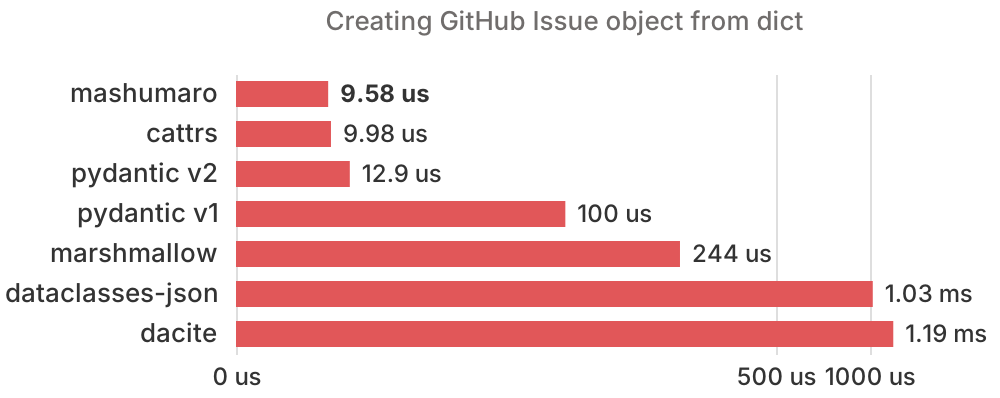
Click to show the result ```json { "type": "array", "items": { "type": "object", "title": "User", "properties": { "id": { "type": "string", "format": "uuid" }, "name": { "type": "string", "description": "User name" } }, "additionalProperties": false, "required": [ "id", "name" ] } } ```
Additional validation keywords ([see below](#json-schema-constraints)) can be added using annotations: ```python from typing import Annotated, List from mashumaro.jsonschema import build_json_schema from mashumaro.jsonschema.annotations import Maximum, MaxItems print( build_json_schema( Annotated[ List[Annotated[int, Maximum(42)]], MaxItems(4) ] ).to_json() ) ```
Click to show the result ```json { "type": "array", "items": { "type": "integer", "maximum": 42 }, "maxItems": 4 } ```
The [`$schema`](https://json-schema.org/draft/2020-12/json-schema-core.html#name-the-schema-keyword) keyword can be added by setting `with_dialect_uri` to True: ```python print(build_json_schema(str, with_dialect_uri=True).to_json()) ```
Click to show the result ```json { "$schema": "https://json-schema.org/draft/2020-12/schema", "type": "string" } ```
By default, Draft 2022-12 dialect is being used, but you can change it to another one by setting `dialect` parameter: ```python from mashumaro.jsonschema import OPEN_API_3_1 print( build_json_schema( str, dialect=OPEN_API_3_1, with_dialect_uri=True ).to_json() ) ```
Click to show the result ```json { "$schema": "https://spec.openapis.org/oas/3.1/dialect/base", "type": "string" } ```
All dataclass JSON Schemas can or can not be placed in the [definitions](https://json-schema.org/draft/2020-12/json-schema-core.html#name-schema-re-use-with-defs) section, depending on the `all_refs` parameter, which default value comes from a dialect used (`False` for Draft 2022-12, `True` for OpenAPI Specification 3.1.1): ```python print(build_json_schema(List[User], all_refs=True).to_json()) ```
Click to show the result ```json { "type": "array", "$defs": { "User": { "type": "object", "title": "User", "properties": { "id": { "type": "string", "format": "uuid" }, "name": { "type": "string" } }, "additionalProperties": false, "required": [ "id", "name" ] } }, "items": { "$ref": "#/$defs/User" } } ```
The definitions section can be omitted from the final document by setting `with_definitions` parameter to `False`: ```python print( build_json_schema( List[User], dialect=OPEN_API_3_1, with_definitions=False ).to_json() ) ```
Click to show the result ```json { "type": "array", "items": { "$ref": "#/components/schemas/User" } } ```
Reference prefix can be changed by using `ref_prefix` parameter: ```python print( build_json_schema( List[User], all_refs=True, with_definitions=False, ref_prefix="#/components/responses", ).to_json() ) ```
Click to show the result ```json { "type": "array", "items": { "$ref": "#/components/responses/User" } } ```
The omitted definitions could be found later in the `Context` object that you could have created and passed to the function, but it could be easier to use `JSONSchemaBuilder` for that. For example, you might found it handy to build OpenAPI Specification step by step passing your models to the builder and get all the registered definitions later. This builder has reasonable defaults but can be customized if necessary. ```python from mashumaro.jsonschema import JSONSchemaBuilder, OPEN_API_3_1 builder = JSONSchemaBuilder(OPEN_API_3_1) @dataclass class User: id: UUID name: str @dataclass class Device: id: UUID model: str print(builder.build(List[User]).to_json()) print(builder.build(List[Device]).to_json()) print(builder.get_definitions().to_json()) ```
Click to show the result ```json { "type": "array", "items": { "$ref": "#/components/schemas/User" } } ``` ```json { "type": "array", "items": { "$ref": "#/components/schemas/Device" } } ``` ```json { "User": { "type": "object", "title": "User", "properties": { "id": { "type": "string", "format": "uuid" }, "name": { "type": "string" } }, "additionalProperties": false, "required": [ "id", "name" ] }, "Device": { "type": "object", "title": "Device", "properties": { "id": { "type": "string", "format": "uuid" }, "model": { "type": "string" } }, "additionalProperties": false, "required": [ "id", "model" ] } } ```
### JSON Schema constraints Apart from required keywords, that are added automatically for certain data types, you're free to use additional validation keywords. They're presented by the corresponding classes in [`mashumaro.jsonschema.annotations`](https://github.com/Fatal1ty/mashumaro/blob/master/mashumaro/jsonschema/annotations.py): Number constraints: * [`Minimum`](https://json-schema.org/draft/2020-12/json-schema-validation.html#name-minimum) * [`Maximum`](https://json-schema.org/draft/2020-12/json-schema-validation.html#name-maximum) * [`ExclusiveMinimum`](https://json-schema.org/draft/2020-12/json-schema-validation.html#name-exclusiveminimum) * [`ExclusiveMaximum`](https://json-schema.org/draft/2020-12/json-schema-validation.html#name-exclusivemaximum) * [`MultipleOf`](https://json-schema.org/draft/2020-12/json-schema-validation.html#name-multipleof) String constraints: * [`MinLength`](https://json-schema.org/draft/2020-12/json-schema-validation.html#name-minlength) * [`MaxLength`](https://json-schema.org/draft/2020-12/json-schema-validation.html#name-maxlength) * [`Pattern`](https://json-schema.org/draft/2020-12/json-schema-validation.html#name-pattern) Array constraints: * [`MinItems`](https://json-schema.org/draft/2020-12/json-schema-validation.html#name-minitems) * [`MaxItems`](https://json-schema.org/draft/2020-12/json-schema-validation.html#name-maxitems) * [`UniqueItems`](https://json-schema.org/draft/2020-12/json-schema-validation.html#name-uniqueitems) * [`Contains`](https://json-schema.org/draft/2020-12/json-schema-core.html#name-contains) * [`MinContains`](https://json-schema.org/draft/2020-12/json-schema-validation.html#name-mincontains) * [`MaxContains`](https://json-schema.org/draft/2020-12/json-schema-validation.html#name-maxcontains) Object constraints: * [`MaxProperties`](https://json-schema.org/draft/2020-12/json-schema-validation.html#name-maxproperties) * [`MinProperties`](https://json-schema.org/draft/2020-12/json-schema-validation.html#name-minproperties) * [`DependentRequired`](https://json-schema.org/draft/2020-12/json-schema-validation.html#name-dependentrequired) ### JSON Schema plugins If the built-in functionality doesn't meet your needs, you can customize the JSON Schema generation or add support for additional types using plugins. The [`mashumaro.jsonschema.plugins.BasePlugin`](https://github.com/Fatal1ty/mashumaro/blob/32179eac1927483f4da015f711b07c04e8b2b2b9/mashumaro/jsonschema/plugins.py#L9-L16) class provides a `get_schema` method that you can override to implement custom behavior. The plugin system works by iterating through all registered plugins and calling their `get_schema` methods. If a plugin's `get_schema` method raises a `NotImplementedError` or returns `None`, it indicates that the plugin doesn't provide the required functionality for that particular case. You can apply multiple plugins sequentially, allowing each to modify the schema in turn. This approach enables a step-by-step transformation of the schema, with each plugin contributing its specific modifications. Plugins can be registered using the `plugins` argument in either the `build_json_schema` function or the `JSONSchemaBuilder` class. The [`mashumaro.jsonschema.plugins`](https://github.com/Fatal1ty/mashumaro/blob/master/mashumaro/jsonschema/plugins.py) module contains several built-in plugins. Currently, one of these plugins adds descriptions to JSON schemas using docstrings from dataclasses: ```python from dataclasses import dataclass from mashumaro.jsonschema import build_json_schema from mashumaro.jsonschema.plugins import DocstringDescriptionPlugin @dataclass class MyClass: """My class""" x: int schema = build_json_schema(MyClass, plugins=[DocstringDescriptionPlugin()]) print(schema.to_json()) ```
Click to show the result ```json { "type": "object", "title": "MyClass", "description": "My class", "properties": { "x": { "type": "integer" } }, "additionalProperties": false, "required": [ "x" ] } ```
Creating your own custom plugin is straightforward. For instance, if you want to add support for Pydantic models, you could write a plugin similar to the following: ```python from dataclasses import dataclass from pydantic import BaseModel from mashumaro.jsonschema import build_json_schema from mashumaro.jsonschema.models import Context, JSONSchema from mashumaro.jsonschema.plugins import BasePlugin from mashumaro.jsonschema.schema import Instance class PydanticSchemaPlugin(BasePlugin): def get_schema( self, instance: Instance, ctx: Context, schema: JSONSchema | None = None, ) -> JSONSchema | None: try: if issubclass(instance.type, BaseModel): pydantic_schema = instance.type.model_json_schema() return JSONSchema.from_dict(pydantic_schema) except TypeError: return None class MyPydanticClass(BaseModel): x: int @dataclass class MyDataClass: y: MyPydanticClass schema = build_json_schema(MyDataClass, plugins=[PydanticSchemaPlugin()]) print(schema.to_json()) ```
Click to show the result ```json { "type": "object", "title": "MyDataClass", "properties": { "y": { "type": "object", "title": "MyPydanticClass", "properties": { "x": { "type": "integer", "title": "X" } }, "required": [ "x" ] } }, "additionalProperties": false, "required": [ "y" ] } ```
### Extending JSON Schema Using a `Config` class it is possible to override some parts of the schema. Currently, you can do the following: * override some field schemas using the "properties" key * change `additionalProperties` using the "additionalProperties" key ```python from dataclasses import dataclass from mashumaro.jsonschema import build_json_schema @dataclass class FooBar: foo: str bar: int class Config: json_schema = { "properties": { "foo": { "type": "string", "description": "bar" } }, "additionalProperties": True, } print(build_json_schema(FooBar).to_json()) ```
Click to show the result ```json { "type": "object", "title": "FooBar", "properties": { "foo": { "type": "string", "description": "bar" }, "bar": { "type": "integer" } }, "additionalProperties": true, "required": [ "foo", "bar" ] } ```
You can also change the "additionalProperties" key to a specific schema by passing it a `JSONSchema` instance instead of a bool value. ### JSON Schema and custom serialization methods Mashumaro provides different ways to override default serialization methods for dataclass fields or specific data types. In order for these overrides to be reflected in the schema, you need to make sure that the methods have annotations of the return value type. ```python from dataclasses import dataclass, field from mashumaro.config import BaseConfig from mashumaro.jsonschema import build_json_schema def str_as_list(s: str) -> list[str]: return list(s) def int_as_str(i: int) -> str: return str(i) @dataclass class FooBar: foo: str = field(metadata={"serialize": str_as_list}) bar: int class Config(BaseConfig): serialization_strategy = { int: { "serialize": int_as_str } } print(build_json_schema(FooBar).to_json()) ```
Click to show the result ```json { "type": "object", "title": "FooBar", "properties": { "foo": { "type": "array", "items": { "type": "string" } }, "bar": { "type": "string" } }, "additionalProperties": false, "required": [ "foo", "bar" ] } ```